
Updated October 2026: I wrote this in March 2012, when we had just started making Roasted oil at our new factory in Kallarpe. Some things have changed since; see “How we make it today” at the end.
Roasted and cold pressed coconut oil come from the same dried coconut, but they are made differently, and they look, smell and taste different. Here is how each is made, and why both are pure coconut oil.
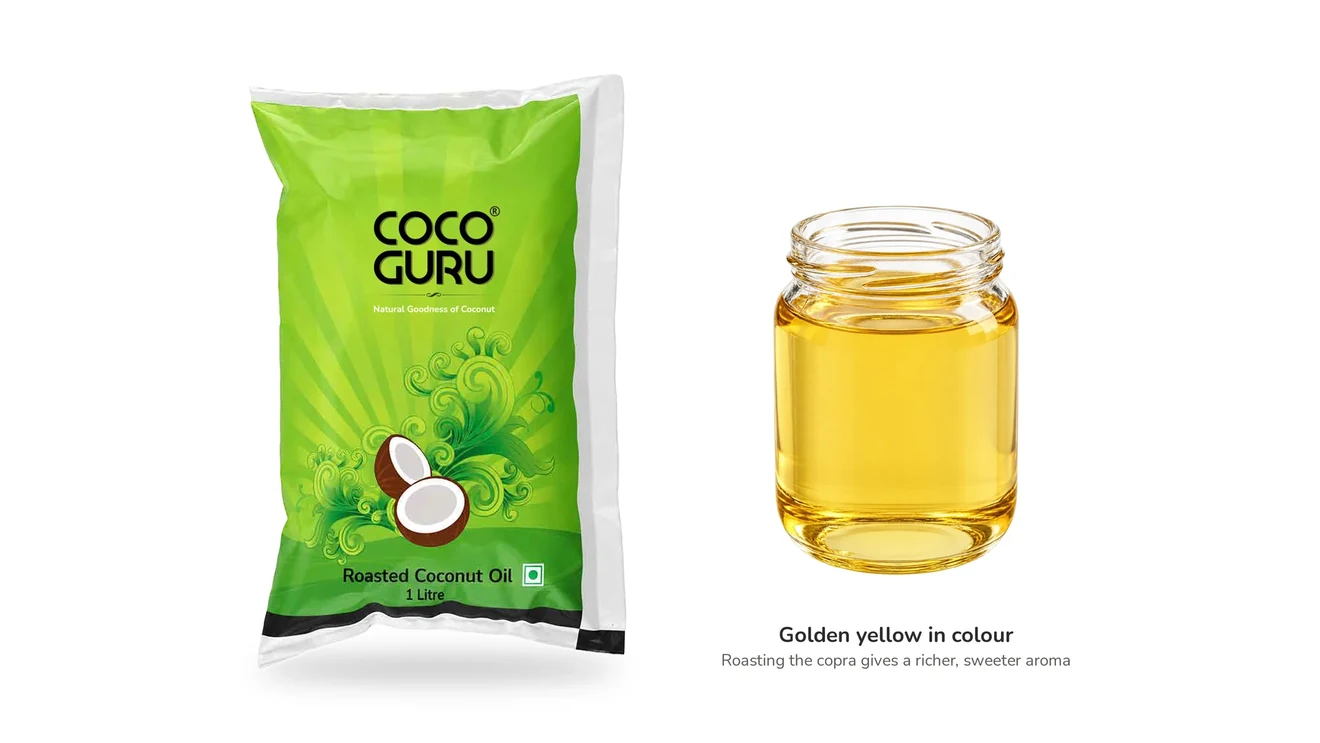

Our new factory at Kallarpe (Aryapu Village, Puttur) makes Roasted coconut oil. New customers liked it straight away for its richer aroma and taste. But customers who were used to the cold pressed oil from our earlier factory at Parladka (Puttur) had doubts. This post answers them.
Cold pressed coconut oil
Virgin coconut oil is often called cold pressed coconut oil, but the two are different: virgin oil is made from fresh coconut, while the cold pressed oil in this post is made from dried coconut (copra).
Copra with about 8% moisture is crushed as it is in a rotary mill (ghani). The oil is then left in tanks for seven days, so the solid particles settle out. The method is very simple and needs little investment.
The oil is crystal clear, with the natural smell and taste of copra. Many people prefer it as a natural, locally made product.
Roasted coconut oil
The copra is first cut into small pieces and dried further with hot air, to about 2.5% moisture. The pieces are then roasted for about an hour in a steam-jacketed vessel with several stages. A little steam is let in to cook the copra, which opens up the fat cells so the oil comes out more easily. The oil is then filtered through a filter press to remove the sediment.
This needs more investment — a steam boiler, pipelines, and a cooker with a stirrer and motor — and costs more to run, in fuel and electricity. It also costs more for another reason: the oil cake left over after roasting sells for a lower price.
The oil is golden yellow, with a distinct nutty aroma and taste, much like roasted groundnuts.
Does the heat harm the oil?
During roasting, the oil and oil cake reach up to 100°C, against about 60°C in cold pressing. The higher heat drives out more moisture, which lowers the risk of the oil going rancid. Roasting also sterilises the copra, killing bacteria and fungi, so the oil keeps longer.
In many oils, high heat breaks the fat down into free fatty acids, which makes the oil rancid. Coconut oil is mostly saturated fat and stays stable, so roasting does not harm its quality.
Price and acceptance in 2012
Hair oil makers prefer roasted coconut oil for its aroma and longer shelf life, and in the bulk market it sells for about 5% more than cold pressed oil. Even so, we sell both to consumers at the same price. Roasted oil is still new in Dakshina Kannada and not yet widely accepted, so we are explaining its benefits to our customers.
Both are pure coconut oil
For all their differences, both are pure coconut oil. Both are made from the same quality of copra, have the same chemical make-up, and offer the same health benefits of coconut oil.
| Parameter | Cold pressed (2012) | Roasted (2012) |
|---|---|---|
| Copra moisture | About 8% | About 2.5%, then roasted |
| Crushing | Rotary mill (ghani) | After about an hour of roasting with steam |
| Highest temperature | About 60°C | Up to 100°C |
| Clearing the oil | Settling, 7 days | Filter press |
| Colour | Crystal clear | Golden yellow |
| Aroma and taste | Natural copra | Nutty, like roasted groundnuts |
| Investment | Low | High |
For a side-by-side guide to our two oils today, see Roasted vs Cold Pressed.
How we make it today
- Drying. For all our oils, the copra is dried with hot air at 80°C, to 2.5% moisture.
- Roasted. Our Roasted oil is still made the way this post describes. It is mildly roasted, to suit cooking.
- Cold Pressed. Until 2020, we made cold pressed oil in small quantities with a ghani and sold it only at our counter in Yelmudi, Puttur. We moved to an expeller in 2019, and since 2020 we have made Cold Pressed oil on a large scale and sold it in consumer packs across our area. Only oil from the first crushing goes into it, and it is cleared in a filter press the same day.
- Price. Roasted oil now costs more than Cold Pressed: about ₹ 15 a litre more at wholesale and ₹ 20 a litre more for consumers.
- Who buys which. People used to Roasted oil stay with it. Urban and online buyers tend to prefer Cold Pressed — not for the price, but because of a common belief that anything cold pressed is better.
- Both have their place. Roasted oil is better where a strong coconut aroma is wanted; cold pressed oil is better for deep frying, or where the coconut aroma should not overpower other flavours.